

Imagine standing at the nursery gates, watching your three-year-old clutch their bag, whilst you secretly wonder if they are truly ready for this next big step. It’s a moment every parent remembers, filled with a mix of pride and a little bit of natural anxiety. You want to find a nursery for 3 and 4 year olds that feels like a second home, but the technical side of childcare can often feel like a puzzle. Between checking your eligibility for 30 hours of funded childcare and worrying if a setting is “too much like school” too soon, it is easy to feel overwhelmed.
We understand that you want a balance of gentle care and meaningful learning. This guide provides the clarity you need to manage the details of funding, curriculum, and school readiness to find the perfect setting for these critical pre-school years. We will look at how to secure your 30-hour funded place, what to look for in a nurturing EYFS environment, and how the right nursery helps your child develop the social confidence they need to thrive when primary school eventually arrives.
Key Takeaways
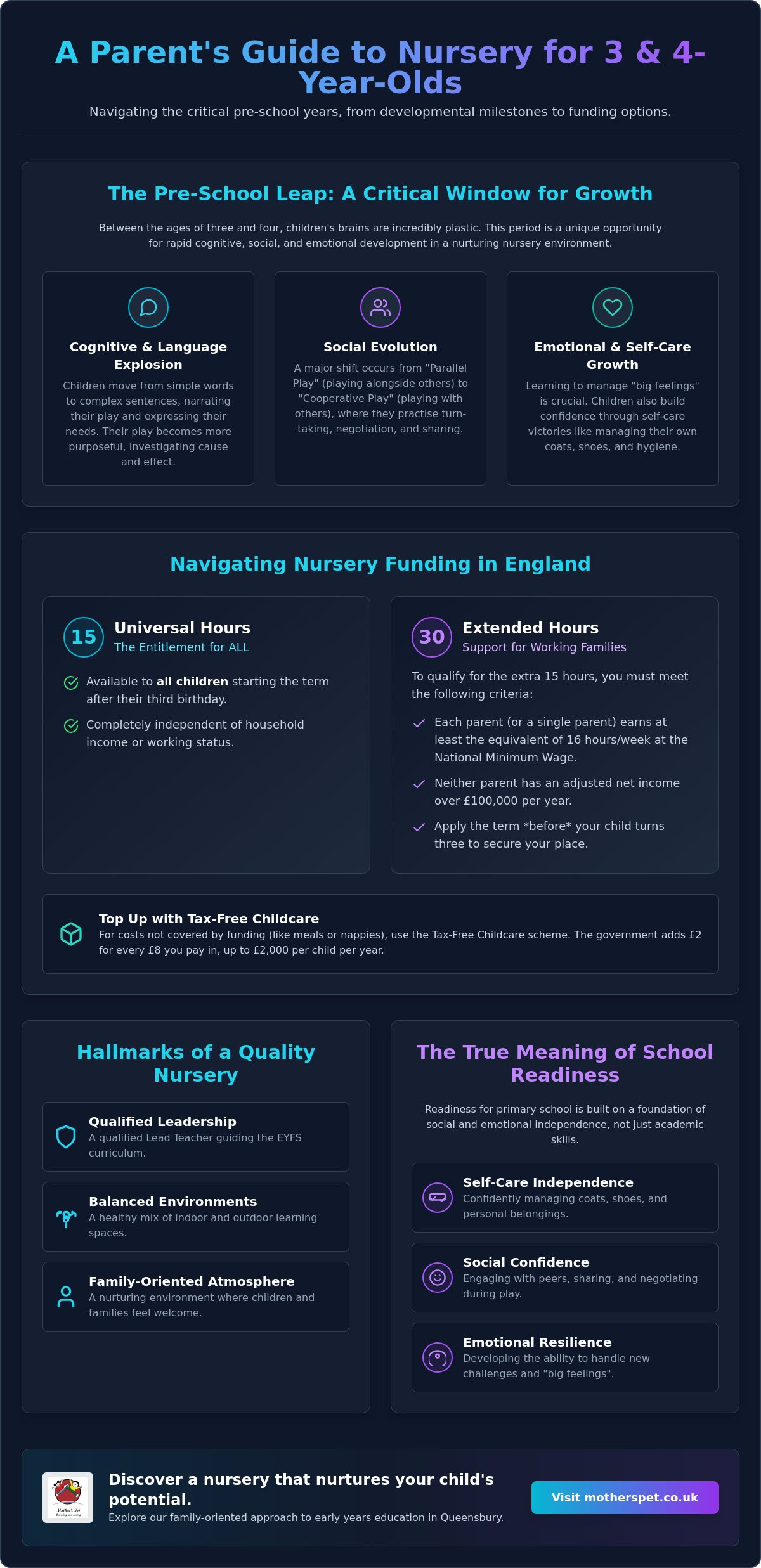
- Understand why the pre-school stage is a vital developmental window where children move from playing alongside others to building cooperative social bonds.
- Learn how to navigate the 15-hour universal entitlement and the 30-hour extended funding to secure your child’s place in a nursery for 3 and 4 year olds.
- Identify the hallmarks of a quality setting, from the qualifications of the Lead Teacher to the balance between indoor and outdoor learning environments.
- Discover why “school readiness” is about nurturing social and emotional independence, such as self-dressing and confidence, rather than purely academic skills.
- Explore how a family-oriented atmosphere and tailored EYFS programmes can help your child reach their full potential before they start primary school.
Why the 3 to 4 Year Old Stage is a Critical Developmental Window
The years between a child’s third and fifth birthdays are often called the “pre-school phase.” This period represents the final, vital chapter of the Early Years Foundation Stage (EYFS) before your little one enters the world of formal education. During this time, a child’s brain is incredibly plastic, making it a critical developmental window for both cognitive and emotional growth. Choosing a high-quality nursery for 3 and 4 year olds provides the structured yet nurturing environment required to make the most of this unique stage.
By the age of four, most children experience a rapid expansion in their vocabulary. They move from simple labels to using complex sentence structures to narrate their play and express their needs. It’s a wonderful time of discovery. However, this growth also brings the challenge of emotional regulation. Learning how to manage “big feelings” is an essential skill that must be nurtured before they face the larger, busier environment of a primary school classroom. A supportive setting helps them build the resilience they’ll need to thrive.
The Shift from Physical Care to Cognitive Challenge
As children turn three, their play becomes more purposeful. They are natural scientists who use messy play with sand, water, or clay to investigate cause and effect. In a dedicated nursery for 3 and 4 year olds, practitioners use “sustained shared thinking” to support this. This involves an adult and a child working together to solve a problem or clarify a concept. These interactions help children move away from the simple routines of toddlerhood and towards more structured group learning sessions that challenge their thinking and curiosity.
Social Milestones: Building Friendships and Empathy
One of the most significant shifts at this age is the transition from “parallel play” to true cooperative interaction. Instead of simply playing alongside their peers, three and four year olds begin to play with them. They need a consistent peer group to practice turn-taking, negotiation, and sharing. This is also when children develop “Theory of Mind.” This is the psychological milestone where a child realises that other people have thoughts, feelings, and perspectives that are different from their own.
A nurturing nursery environment also fosters vital independence in self-care. We encourage children to take pride in:
- Washing and drying their hands independently.
- Managing their own coats and shoes.
- Using the toilet with confidence.
- Understanding basic hygiene and healthy eating choices.
These small victories in self-reliance build a foundation of social confidence that serves them well for the rest of their lives.
Understanding Childcare Funding: 15 and 30 Free Hours in 2026
Accessing a high-quality nursery for 3 and 4 year olds shouldn’t be a source of financial stress. In England, every family receives a helping hand through the universal 15-hour entitlement. This is available to all children starting the term after their third birthday, regardless of your household income. In 2026, the national average funding rate paid to local authorities for three and four-year-olds is £6.42 per hour. While this funding supports the core learning requirements of a quality nursery, many working families can access even more support.
The extended 30-hour entitlement is designed for working parents who need more substantial childcare. To qualify, each parent (or a single parent) must expect to earn at least the equivalent of 16 hours a week at the National Minimum Wage. However, if either parent has an adjusted net income of over £100,000 a year, they won’t be eligible for the extra hours. It’s a good idea to apply the term before your child turns three. If your child’s birthday falls between January and March, you should apply by the end of March to secure your place for the April term.
It is helpful to understand that “free hours” typically cover the cost of preschool education and tuition. Some nurseries may ask for a small contribution towards “consumables.” This might include nutritious meals, nappies, or specific extracurricular activities. To help with these costs, you can use the Tax-Free Childcare scheme. For every £8 you pay into your online account, the government adds £2, up to a maximum of £2,000 per child per year. This is a simple, effective way to offset any remaining fees whilst your child enjoys a nursery for 3 and 4 year olds.
How to Apply for Your 30-Hour Eligibility Code
To get started, you’ll need to create a Childcare Service account on GOV.UK. After providing your details and National Insurance number, you will receive an 11-digit eligibility code. You must share this code with your chosen nursery provider as soon as possible. A vital step many parents overlook is reconfirming their details every three months. You’ll receive a prompt from the government; failing to reconfirm can lead to a gap in your funding, which is difficult to resolve mid-term.
Maximising Your Funding at a Private Nursery
Many private settings offer “stretched” funding. Instead of using 30 hours over 38 weeks of the year, they spread the total 1,140 hours over 51 or 52 weeks. This provides your child with a consistent routine and helps you manage your work schedule without term-time interruptions. If you are looking for 30 hours funded places in the Queensbury or Edgware area, our team is always on hand to help you navigate the paperwork and ensure your child receives the best possible start.
Choosing the Right Setting: What Makes a Quality Nursery in NW9?
While an Ofsted report provides a helpful snapshot, it doesn’t always capture the daily “heartbeat” of a setting. When you visit a nursery for 3 and 4 year olds in the NW9 area, the atmosphere should feel like a steady, comforting extension of your own home. You’re looking for a balance. A space that is too clinical can feel cold, whilst one that is chaotic can be overwhelming for a child still learning to regulate their emotions. A quality nursery should feel purposeful and calm, with children who are deeply engaged in their chosen activities.
The foundation of this calm environment is the Key Person system. This ensures that your child has one specific practitioner who truly understands their unique personality, interests, and quirks. It’s this professional dedication that builds immediate trust, helping your child feel seen and heard every single day. Before you settle on a choice, ask about the qualifications of the Lead Teacher or Manager. A setting led by highly qualified practitioners often provides a more nuanced approach to the Early Years Foundation Stage (EYFS) and better supports individual growth.
The Learning Environment: Indoor and Outdoor Flow
A stimulating nursery for 3 and 4 year olds will prioritise “open-ended” resources over flashy plastic toys. Items like wooden blocks, sand, water, and fabric allow a child’s imagination to lead the way, rather than the toy dictates how they should play. As you tour the setting, look for:
- Quiet Spaces: Cosy corners with soft cushions and a diverse range of books for reflection and reading.
- Creative Zones: Areas where messy play and art are encouraged as a form of expression.
- Outdoor Access: A safe, inviting garden where 4 year olds can develop gross motor skills through climbing, balancing, and running.
This “flow” between indoor and outdoor spaces is vital for physical health and cognitive development.
Staff Interaction and Pedagogical Approach
Watch how the staff interact with the children during your visit. Do they get down to the child’s eye level to talk? This simple act shows respect and helps build a safe, encouraging atmosphere. Ask the team about their approach to “Positive Behaviour Management.” Instead of simply saying “no,” a nurturing expert will help children understand their feelings and find a kind way to resolve conflicts with their peers.
Finally, ask how they track and share progress. A reliable community partner will use the EYFS developmental bands to monitor your child’s journey, providing you with regular, clear updates. This steady, methodical approach ensures that no milestone goes uncelebrated and that any areas needing extra support are identified early, providing a stable foundation for your child’s future.
The Journey to Primary School: Building Essential Readiness Skills
Transitioning from a nursery for 3 and 4 year olds to a primary school reception class is a significant milestone for any family. Many parents worry about whether their child is “academically ready,” but school readiness is actually much broader than just reading or writing. It’s about a child’s social and emotional independence. Can they manage their own belongings? Are they comfortable asking for help? A nurturing pre-school environment focuses on these practical life skills to ensure your little one feels capable and confident on their first day.
We encourage children to master self-dressing, such as pulling on their wellies for outdoor play or fastening a coat. Using the toilet independently and learning to open a lunchbox or a yoghurt pot are also vital skills. These small victories prevent a child from feeling frustrated in a busy school hall and build a sense of “I can do it.” This self-reliance is the best foundation for future learning. It allows them to focus on making friends and exploring their new classroom instead of worrying about basic tasks.
Another key aspect of readiness is building “listening stamina.” In a reception class, children are expected to sit on the carpet for short periods to listen to instructions or a story. A quality nursery for 3 and 4 year olds helps build this gradually. By increasing the length of group sessions in a gentle, engaging way, we help children develop the focus they’ll need without it feeling like a chore. This steady approach respects their age whilst preparing them for the structure of formal schooling.
Early Literacy and Numeracy Without the Pressure
In a preschool setting, literacy and numeracy are woven into the fabric of the day through play. We don’t use dry worksheets. Instead, we use storytelling to build narrative skills and predictive thinking. When a child guesses what might happen next in a book, they’re developing vital cognitive links. Numeracy is taught in context through everyday activities:
- Counting the number of plates needed to set the table for snack time.
- Measuring how many strides it takes to cross the garden area.
- Recognising their own name and letter sounds through interactive games and labels.
These playful experiences ensure that children enjoy learning from the very start.
Emotional Resilience: Handling the Change
Managing the “big feelings” that come with change is a natural part of the journey. We use “settling-in” principles to help children prepare for the larger environment of a school. Mixed-age play is also beneficial; it allows older children to act as role models, which builds their confidence amongst their peers. A vital part of this process is the robust transition report we provide to the new school. This ensures your child’s new teacher understands their unique strengths and interests from day one. If you’d like to see how our preschool education programme prepares your child for this exciting next step, we’d love to welcome you for a visit.
Discovering Mother’s Pet Nursery: Nurturing Your Child’s Potential in Queensbury
Choosing a nursery for 3 and 4 year olds is a deeply personal decision, especially when you are looking for a setting that feels like a second home. Mother’s Pet Nursery has served the Queensbury and Edgware communities for many years, providing a safe, encouraging atmosphere where children can truly flourish. Our location in the heart of NW9 makes us a convenient choice for local parents who value a steady, comforting presence during their child’s final pre-school steps. We pride ourselves on being a reliable community partner that understands the unique needs of families in North West London.
We believe that every child is a unique individual with their own set of interests and talents. Our qualified practitioners specialise in weaving these interests into our tailored EYFS programmes, ensuring that learning remains an exciting adventure rather than a formal task. This approach helps children build the social confidence they need before moving on to local primary schools. Alongside our educational goals, we prioritise nutritional care with healthy, balanced menus that support the physical growth and wellbeing of active preschoolers.
Our Approach to Pre-school Education
In our setting, we strike a careful balance between child-led exploration and the structured learning required for school readiness. Our staff are nurturing experts who focus on building emotional resilience, helping children manage transitions with ease. By providing a stimulating environment filled with open-ended resources, we encourage children to think critically and solve problems together. This professional dedication ensures that every child leaves us feeling capable, confident, and eager to continue their learning journey.
Join Our Community in NW9
We are dedicated to making high-quality care accessible, which is why we support families with 30-hour funded places centrally in Queensbury. Our team is always on hand to help you navigate the details of your entitlement, ensuring a stress-free experience from your very first enquiry. The “Mother’s Pet” difference is found in our patient, consistent care and the genuine, heartfelt bonds we form with our families. We invite you to see our inviting environment for yourself and meet the team. Book a visit to Mother’s Pet Nursery and start your child’s journey today. We look forward to welcoming you into our nursery family.
Secure a Bright Start for Your Child’s Pre-school Years
Choosing the right nursery for 3 and 4 year olds is about more than finding a convenient location; it’s about selecting a community that will nurture your child’s confidence before they take their next big step. We’ve explored how understanding your funding options and focusing on emotional readiness can transform these critical years into a period of joyful discovery. By prioritising a setting that balances structured learning with genuine warmth, you’re giving your little one the best possible foundation for their future education.
As an Ofsted registered provider, we take pride in our nurturing EYFS-based curriculum and our commitment to supporting local families by accepting 30-hour funded places. Our team is here to guide you through every step of the process, from navigating eligibility to settling your child into their new routine. We invite you to enquire about a pre-school place at Mother’s Pet Nursery and see how our family-oriented approach can help your child flourish. We look forward to helping your little one reach their full potential in a safe and happy environment.
Frequently Asked Questions
When should I start looking for a nursery for my 3 year old?
You should ideally begin your search six to nine months before you would like your child to start. Popular settings often have waiting lists; starting early gives you the time to visit different environments and find the right fit. It’s helpful to apply at least one term before your child turns three to ensure your funding is processed in time for the next intake in September, January, or April.
Is my child eligible for 30 hours of free childcare in London?
Eligibility for the extended 30-hour entitlement depends on your working status and income. In 2026, both parents (or a single parent) must each expect to earn at least the equivalent of 16 hours per week at the National Minimum Wage. Additionally, neither parent can have an adjusted net income exceeding £100,000 per year. All 3 and 4 year olds in England are automatically entitled to the universal 15 hours of funding regardless of parental income.
What is the difference between a school nursery and a private nursery like Mother’s Pet?
School nurseries are usually attached to a primary school and follow strict term-time dates and school hours. A private nursery for 3 and 4 year olds often provides more flexibility, offering “stretched” funding over 51 or 52 weeks of the year. Our setting focuses on a family-oriented, nurturing atmosphere that bridges the gap between home and formal education, often with smaller group sizes that allow for more individualised attention.
How does the nursery help with potty training for 3 year olds?
We view potty training as a collaborative journey between the nursery and home. Our practitioners use gentle encouragement and positive reinforcement to help children feel confident and independent. We follow your lead on the routines you’ve started at home, ensuring consistency that helps your child succeed. We focus on building self-care skills, such as hand washing and managing clothing, in a supportive and relaxed environment.
What happens if my child is not yet “school ready” by age 4?
Every child develops at their own pace, and it is perfectly normal for some to need more time with certain skills. We use the EYFS developmental bands to track progress and identify areas where your child might need extra support. If a child isn’t yet fully independent by age four, we tailor our activities to build their resilience and social confidence. Our detailed transition reports ensure their future reception teacher is fully prepared to support them from day one.
Can I use my 15 hours of funding across two different childcare providers?
Yes, you can split your funded hours between two different providers, such as a childminder and a nursery for 3 and 4 year olds. You will need to inform both settings of how you intend to divide the hours so they can coordinate the claims with the local authority. This can be a helpful way to balance different types of care, provided the total hours don’t exceed your overall entitlement of 15 or 30 hours.
How do you ensure the safety and security of children in the Queensbury setting?
Safety is our highest priority, and we maintain a secure environment through strictly controlled entry points and robust safeguarding policies. All our staff undergo enhanced DBS checks and regular training to stay updated on the latest EYFS safeguarding requirements. Our Queensbury centre is designed with child-safe features and clear visibility, ensuring that children can explore and learn in an atmosphere that is both stimulating and secure.
What are the typical daily routines for a 4 year old at your nursery?
A typical day follows a steady, inviting rhythm that balances structured group learning with free-flow play. Four-year-olds enjoy morning welcome circles, nutritious snack times, and plenty of outdoor exploration in our garden. We incorporate playful literacy and numeracy activities throughout the day, whilst also leaving plenty of room for children to follow their own interests. This structure helps them grow accustomed to a routine, which is vital for their upcoming transition to primary school.